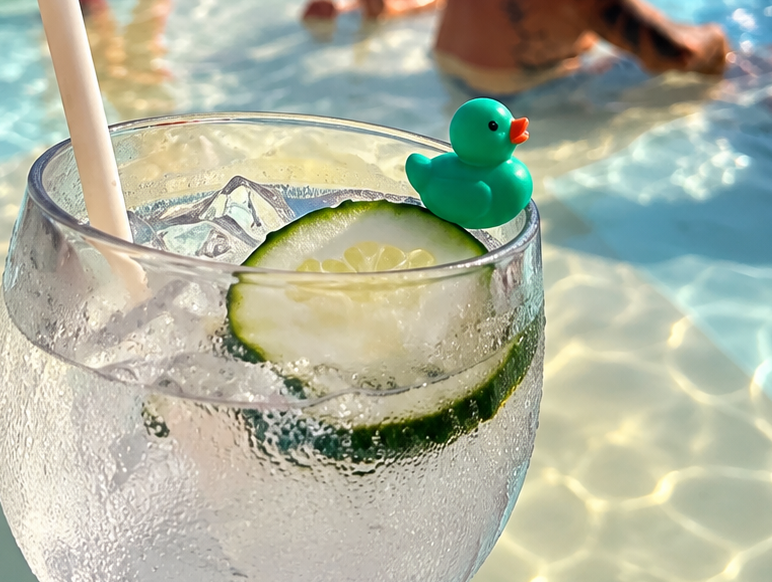
On luck, perspective, and the unexpected adventures of a tiny green rubber duck
The ocean was blue, the sky was blue, and only a thin line on the horizon seemed to separate the two. I was standing at the back of the cruise ship, watching the white trail of water we were leaving behind. There is something mesmerizing about that view, the way the ocean stretches endlessly until it appears to meet the sky. I stood there for a while, enjoying the breeze and the simple pleasure of having nowhere in particular to be. It was one of those moments when you realize how little you actually need to feel happy.

Eventually, I walked back to my chair, completely unaware that the most entertaining part of my afternoon was about to begin. Sitting there, waiting to be discovered, was a tiny green rubber duck.
If you’ve ever been on a cruise, you may have heard about the tradition of hiding rubber ducks around the ship for other passengers to find. Some people collect them, others hide them again, and according to a playful little legend, finding one brings good luck. I wasn’t searching for one, which made the discovery even more exciting. I had simply returned to my chair and found myself the unexpected owner of a lucky duck. Naturally, I wanted to take a photograph.
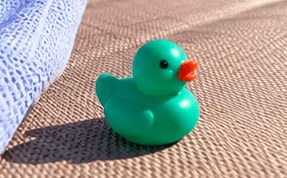
That was my first mistake.
Somehow, while trying to capture the moment, I dropped the duck, and it fell directly into a drain. I watched it disappear, unable to believe what had just happened. One minute I was celebrating my good fortune, and the next I was staring at the place where it had vanished. I had barely had time to enjoy finding it before losing it again.
My first thought was as ridiculous as it was immediate: If finding a rubber duck brings good luck, what does it mean when you lose one down a drain? Does that mean my luck is literally going down the drain?
I laughed at the irony, but I also felt strangely disappointed. Not because the duck was valuable, of course. It was a tiny piece of green plastic. But there was something about finding it so unexpectedly and then losing it almost immediately that made the whole situation feel like a little cosmic joke. For a while, I accepted that the duck was gone and returned to enjoying my afternoon.
This is where I should probably introduce the Cool as a Cucumber, a cocktail that had become my signature drink during the trip. I had developed quite an appreciation for it, and by that afternoon, ordering another one seemed like a perfectly reasonable way to spend my time. Somewhere between enjoying the sunshine, watching the activity around the pool, and having a few Cool as a Cucumbers, my thoughts kept returning to the little green duck.
I began reconsidering my interpretation of what had happened. Perhaps losing the duck wasn’t a sign that my luck had disappeared. Perhaps the good luck had been finding it in the first place. After all, I hadn’t been looking for anything, yet something unexpected had appeared and made me smile. Why was I so quick to turn a pleasant surprise into a story about misfortune simply because it hadn’t ended the way I wanted?
The more I thought about it, the more amusing it became. Here I was, surrounded by the beauty of the ocean, enjoying a wonderful vacation, and contemplating the philosophical implications of losing a rubber duck. I couldn’t help laughing at myself. Still, another thought began to take shape: why was I so willing to accept that the duck was gone? I knew exactly where it had fallen. Surely someone on a ship this large could help me retrieve it.
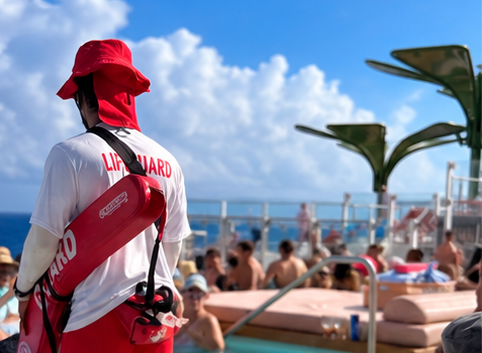
I decided to ask the lifeguards.

Now, I fully appreciate how absurd this must have sounded. These were people responsible for watching over the safety of passengers, and I was approaching them with a concern about a miniature rubber duck trapped in a drain. I explained what had happened, acknowledging that my request was rather unusual, and asked whether there was any possibility of recovering it. They listened and suggested that I speak with security.
Under normal circumstances, that probably would have been the moment when I thanked them, returned to my chair, and forgot about the whole thing. But perhaps the combination of sunshine, vacation freedom, and one too many Cool as a Cucumbers had made me unusually determined. I had decided that the duck represented my good luck, and I wasn’t particularly interested in allowing that luck to disappear beneath the deck of the ship without at least making an effort to recover it.
So I went to security.
I approached the security officer with the full awareness that I was about to make one of the most ridiculous requests he might hear all day. I couldn’t help smiling as I began explaining myself.
“This might be the most ridiculous story you’ve ever heard,” I told him, “but I just found a rubber duck, and I accidentally dropped it down a drain.”
I could have stopped there, but somehow that didn’t seem to communicate the seriousness of my situation. So I continued, explaining that finding a rubber duck on a cruise was supposed to bring good luck and that, while I understood how insignificant the object might appear, I really didn’t want my luck disappearing down the drain.
“You may think it’s not important,” I said, “but it’s about my luck! I don’t want my luck to go down the drain!”
Even as I spoke, I was laughing at how completely irrational the conversation sounded. I was a grown woman explaining to a ship’s security officer that I needed assistance recovering my good fortune, which happened to be shaped like a tiny green duck. I can only imagine what he thought of the whole situation.
And yet, to my absolute delight, he helped me.
He retrieved the duck.
I was so happy that you would have thought he had recovered a priceless piece of jewelry rather than a rubber toy. I thanked him enthusiastically, genuinely grateful that he had taken the time to help with something so small. What had begun as an unfortunate little accident had turned into an adventure involving lifeguards, security, and a surprisingly determined passenger who refused to abandon her lucky duck.
At that point, I felt rather victorious. I had questioned my initial interpretation, decided to do something about the situation, and succeeded in recovering my little green companion. It seemed like a perfectly happy ending, and naturally, I thought the occasion deserved a celebration.
Another Cool as a Cucumber seemed appropriate.
Back by the pool, I settled down with my drink and my rescued duck, feeling quite pleased with how everything had turned out. I thought it would be funny to put the duck in my glass and take a photograph. After all, we had been through quite a lot together, and I wanted something to remember the occasion.
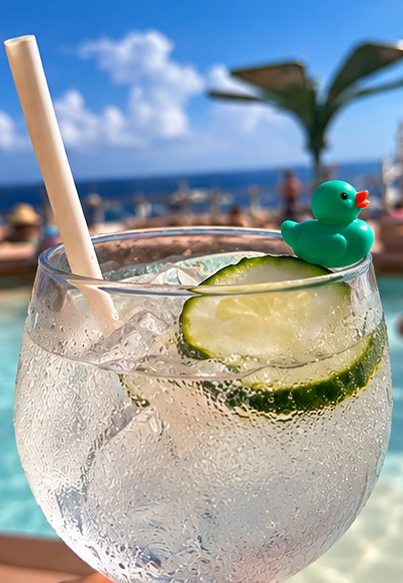
I placed the duck in my drink, reached for my phone, and somehow managed to drop it again.
I am not exaggerating. After all the trouble I had gone through to recover this ridiculous little duck, I had lost it again almost immediately.
For a moment, I simply stared in disbelief. Then I started laughing, because really, what else was there to do? I had just convinced a security officer to help rescue my good luck from a drain, only to demonstrate that I was apparently incapable of keeping a rubber duck safely in my possession.
Fortunately, I managed to retrieve it again, and this time I decided that enough was enough. No more elaborate photographs, no more floating in cocktails, and absolutely no more opportunities for this duck to escape. I held it tightly between my fingers, laughing at the absurdity of the afternoon and wondering how something so small had managed to create so much entertainment.
By then, the duck had become much more than a souvenir. It had become a story, one that I knew I would enjoy telling long after the cruise was over. Not because anything particularly extraordinary had happened, but because the entire experience had been so wonderfully unexpected.
I have spent much of my professional life working as an engineer, analyzing risks, evaluating consequences, and trying to understand what might go wrong before it happens. That way of thinking becomes almost automatic after years of working in technical environments. We question assumptions, examine possibilities, and look for explanations supported by evidence. Yet I find it interesting how easily we abandon that discipline when interpreting our own experiences.
When I first lost the duck, my mind immediately connected the event with the possibility of losing my luck. There was no logical reason to believe that a rubber duck had any influence over my future, and I knew that perfectly well. Still, for a moment, I allowed that interpretation to shape the way I felt about what had happened. Later, when I began looking at the situation differently, my feelings changed even though the facts remained exactly the same.
I think we do this more often than we realize. We experience something unexpected and immediately begin creating a narrative around it. A missed opportunity becomes evidence that we aren’t good enough. A change of plans feels like a setback. A disappointment becomes a sign that things aren’t going our way. Sometimes those interpretations are reasonable, but other times they are simply the first explanations that come to mind, and we accept them without considering that there might be another way of understanding what happened.
Of course, I don’t believe that changing our perspective magically changes reality. There are genuine disappointments, difficult circumstances, and losses that cannot be resolved by deciding to think positively. But there is a difference between acknowledging what has happened and assuming that our first interpretation is the only possible one. Sometimes questioning the meaning we attach to an experience gives us enough room to respond differently.
In my case, the consequences were hardly life-changing. I lost a duck, decided I wanted it back, and found someone willing to help me retrieve it. But the experience reminded me of something I sometimes forget when life becomes busy and responsibilities begin to accumulate: not everything needs to be taken so seriously.
There was something wonderfully liberating about allowing myself to be ridiculous. I didn’t need to justify why I wanted the duck back, and I didn’t particularly care whether the security officer thought my request was silly. I was enjoying myself, laughing at my own determination, and turning an ordinary afternoon into a memory that would probably stay with me longer than many of the more carefully planned activities of the trip.
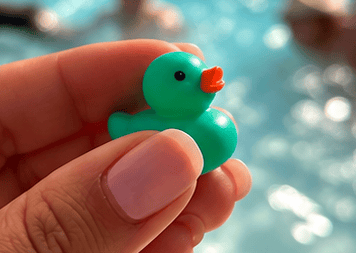
Perhaps that’s one of the things I appreciate most about traveling. Away from our routines and familiar responsibilities, we sometimes give ourselves permission to behave a little differently. We become more curious, more spontaneous, and more willing to enjoy the unexpected. We notice things that might otherwise escape our attention, and occasionally we discover that the smallest experiences leave the strongest impressions.
By the end of the afternoon, I was holding that tiny green duck as though it were something precious. In one of the photographs, you can see how tightly I was gripping it, determined not to let it escape again. Looking at the picture makes me laugh because I know that the duck itself has almost no monetary value. Yet I wouldn’t exchange it for anything from the ship’s gift shop.
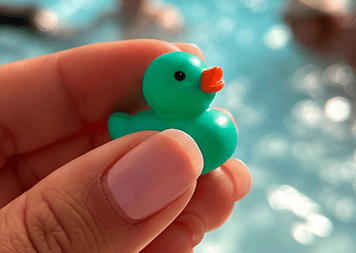
Its value comes entirely from the memory attached to it. Every time I look at it, I’ll remember the beautiful blue horizon, the excitement of finding it on my chair, the disbelief of watching it disappear into the drain, and the wonderfully absurd conversation with security. I’ll remember the relief of getting it back, the Cool as a Cucumbers, and the laughter when I managed to drop it again.
And perhaps, most of all, I’ll remember how much fun I had simply allowing the afternoon to unfold without worrying about whether everything was going according to plan.
Later, I looked again at the photograph I had taken before finding the duck. The ocean and sky appeared to meet at the horizon, separated by a thin line that existed only because of where I was standing. From another perspective, the view would have been different. I found myself smiling at the connection, because in a rather unexpected way, that was exactly what my little adventure had been about.
I had started the afternoon believing that finding a duck meant good luck and losing it meant the opposite. By the end, I was no longer particularly concerned about what the tradition was supposed to mean. I had enjoyed a beautiful day, met people who were kind enough to help with a silly request, laughed more than I expected, and collected a memory I would carry home with me.
If that isn’t good luck, I’m not sure what is.
As for my little green duck, I’m happy to report that he’s still with me. After everything we’ve been through, I have every intention of bringing him home. I found him, lost him, convinced security to rescue him, celebrated his return, and somehow managed to lose him again before finally getting him safely back into my hands.
I suppose some relationships are simply more complicated than others.
And after all that effort, I think it’s fair to say that this is no longer just a lucky duck.
It’s a committed relationship.
Maybe luck isn’t something we find. Maybe it’s something we choose to see.
— Mairim Neves






Leave a Reply